Bangle Size Chart & Guide
At Wayleigh, we believe sizing is more than numbers – it’s about comfort, confidence, and the joy of jewellery that feels natural to wear.
That’s why we’ve created this simple bangle size guide. Whether you’re choosing a gift or selecting a piece for yourself, this guide will help you measure with ease and ensure your bangle slips on gracefully, rests securely, and feels as natural as it looks.
Defining a Bangle?
When we talk about bangles here, we mean closed, rigid circles or elliptical-shaped jewellery worn around the wrist. These are different from cuffs, hinged bangles, or open bangles – each has its own sizing. This guide focuses solely on the timeless, unbroken circle.
Take a look at this guide for the Wayleigh cuff bracelet size chart and measuring guide.
How to Measure Your Bangle Size
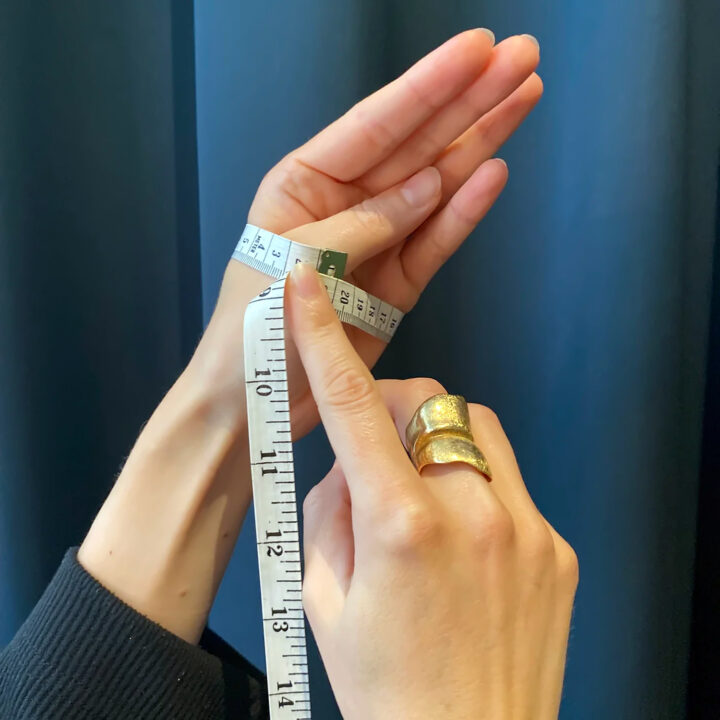
To accurately measure your bangle size, all that’s needed is a flexible measuring tape. If you don’t have one to hand, a piece of ribbon or string and a straight ruler works just as well.
To take your measurement, position your hand as if you’re sliding a bangle on by tucking your thumb into your palm as shown in the image above.
Wrap the tape around the widest part of your hand and note the measurement where the tape overlaps. This is your hand circumference.
If using ribbon or string, mark the overlap and measure against a straight ruler.
Women’s Bangle Sizes
| Size | Hand Circumference | Internal Diameter |
|---|---|---|
| Women Small | 140 – 152 mm | 50 – 54 mm |
| Women Medium | 152 – 165 mm | 55 – 58 mm |
| Women Large | 165 – 178 mm | 59 – 62 mm |
Men’s Bangle Sizes
| Size | Hand Circumference | Internal Diameter |
|---|---|---|
| Men Small | 165 – 178 mm | 59 – 62 mm |
| Men Medium | 178 – 190 mm | 63 – 65 mm |
| Men Large | 190 – 203 mm | 66 – 68 mm |
Kid’s Bangle Sizes
| Size | Hand Circumference | Internal Diameter |
|---|---|---|
| Kids Small | ~140 mm | 48 – 50 |
| Kids Medium | ~152 mm | 50 – 52 |
| Kids Large | ~165 mm | 53 – 55 |
Understanding Bangle Size Charts
You may have noticed that different brands use different systems: some list circumference, others diameter. Luckily, converting between the two is simple:
To convert diameter to circumference, multiply the diameter by 3.14 (C = 3.14 x D). For example, a bangle with an internal diameter of 65mm will have a circumference of 204mm (3.14mm x 65mm = 204mm).
To convert circumference to diameter, divide the circumference by 3.14 (D = C ÷ 3.14). For example, a circumference of 204mm corresponds to a diameter of 65mm (204mm ÷ 3.14 = 65 mm).